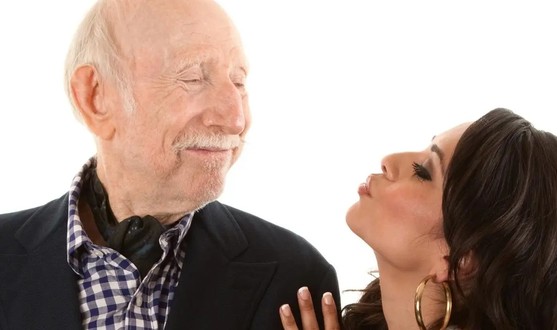
Open any entertainment feed and the same scene repeats. A well-known actor in his 50s appears with a partner in her 20s, the comments fill with the same arguments, and a week later a different couple sets it off again. Age-gap pairings seem to cluster around fame in a way they do not in ordinary life. The reasons have less to do with romance than with the specific conditions fame creates, and looking at those conditions explains why the pattern is so visible at the top and so much rarer in the middle.
The Numbers on Age Gaps
The first thing the data shows is that large gaps are uncommon for most people. About 60% of married couples in the United States are within 3 years of each other, and roughly 92% are within 10. When a gap does appear, it usually goes in one direction. Census data analyzed by Pew found that 40% of married couples have a husband 3 or more years older, against 10% with a wife 3 or more years older.
Those proportions have held steady since 1970 in wealthy countries. Age-gap relationships are not rising or falling as a share of all couples. What changes is how visible they are, and celebrity culture is where they get the most attention. The gap that looks everywhere in headlines is a rounding error in the census. The visibility gap warps expectations. People absorb the celebrity version as if it were the norm, then judge their own choices, or other people’s, against a sample that was never representative. The headlines are a record of the rare, not a map of how most couples pair off.
The Celebrity Difference
Fame removes most of the practical friction that makes age gaps hard for everyone else. Money is the obvious part. A couple with separate fortunes does not argue about one person being ready to retire while the other pays down debt, which is one of the common strains in age-gap relationships off-screen.
The second part is insulation. Ordinary couples with a wide gap face daily judgment from family and coworkers. A famous couple faces judgment too, but from a distance, filtered through publicists and a public they never meet. Their social circle already spans ages and life stages, so an older partner and a younger one are not unusual inside the world they live in. The pool a celebrity selects from is wide, wealthy, and used to unconventional pairings, and all three of those lower the cost of choosing across a generation. Time works differently at that level too. A demanding career can compress or delay the usual life stages, so a 50-year-old and a 28-year-old in the same industry may be closer in daily rhythm than the numbers suggest. Shared work and constant travel can matter more than birth year, and fame tends to scramble both.
The Appeal of an Older Partner
Strip away the cameras and the motivations look more familiar. People drawn to an older partner often point to steadiness, financial security, and a partner who knows what they want. For many of them, the draw is maturity and direction, not just wanting to date a sugar daddy, as the cliché assumes. The stereotype flattens a range of motives into one tired assumption.
Older partners describe the appeal from their side as energy and a fresh perspective on things they had stopped noticing. Neither side of that is unique to the famous. The difference is that a celebrity can act on the preference without the financial and social penalties that make most people think twice. What gets lost in the gossip is that most of these choices are ordinary preferences taken to an unusual setting. A pull toward someone settled, or toward someone still curious about the world, is common at every income level. Fame does not create the preference. It only removes the friction that usually keeps it quiet.
Stigma and Social Judgment
The judgment celebrities are partly shielded from is the main obstacle for everyone else. Research on age-gap stigma finds higher rates of social isolation, stereotyping, and emotional distress than similarly aged couples report, and the wider the gap, the stronger the effect. The pressure is not imaginary. It comes from family questions, workplace assumptions, and the constant low-grade judgment of strangers who see the pairing as something other than what it is.
The weight of that judgment falls hardest on the young. Around 23% of Americans aged 18 to 34 say they worry about social judgment for age-gap dating, compared with 12% of those aged 35 to 54 and 7% of those aged 55 and older. The people most likely to enter such a relationship are also the most exposed to stigmatization for it, which is part of why the pattern looks glamorous when a celebrity does it and risky when an ordinary person does.
Stability and the Long Run
Research on how these relationships last complicates the glamorous version. Couples often start with higher satisfaction when one partner is younger, but that edge tends to fade within 6 to 10 years, and differently aged couples report steeper declines than similarly aged ones. An analysis from Emory University found that divorce risk climbs with the gap, roughly 18% higher at a 5-year difference and 39% higher at a 10-year difference.
The picture is not all warning. The same body of work finds that couples who talk openly about the gap and build around shared goals report strong, lasting bonds. What predicts success is how directly two people deal with what the years between them bring, far more than the size of the gap itself. Celebrities tend to have the resources to absorb the strain. Everyone else has to manage it in plainer terms. A famous couple can travel to escape attention and absorb a rough patch on savings most people will never have. The same rough patch, for an ordinary couple, arrives with a tighter budget and a louder crowd of opinions.
The Limits of the Comparison
The reason celebrities and age-gap relationships seem made for each other is that fame quietly removes the money worries and the social judgment that make such relationships hard for everyone else. Take those away and what looks daring becomes ordinary. The headline couple proves less about age gaps than about what enough money and distance can smooth over. The smoothness is purchased. It does not come free with the relationship, and it does not transfer to a couple living on ordinary terms.
For anyone tempted to use celebrities as a model for ordinary love, the useful move is to subtract the fame and ask what is left. Sometimes it is a genuine match that would survive anywhere. Often it is a set of conditions no ordinary couple has. The pattern at the top says very little about the odds in the middle, and mistaking one for the other is how a glossy headline turns into a hard year.
Conclusion
Celebrity age-gap relationships attract attention because they are highly visible, not because they reflect how most relationships work. Fame can reduce many of the financial and social pressures that make wider age gaps more challenging for ordinary couples, but it does not change the foundations of a healthy relationship. Shared values, honest communication, mutual respect, and compatible life goals remain far more important than the number of years between two people. Looking beyond celebrity headlines offers a more balanced understanding of age-gap relationships and helps separate public fascination from everyday reality.